
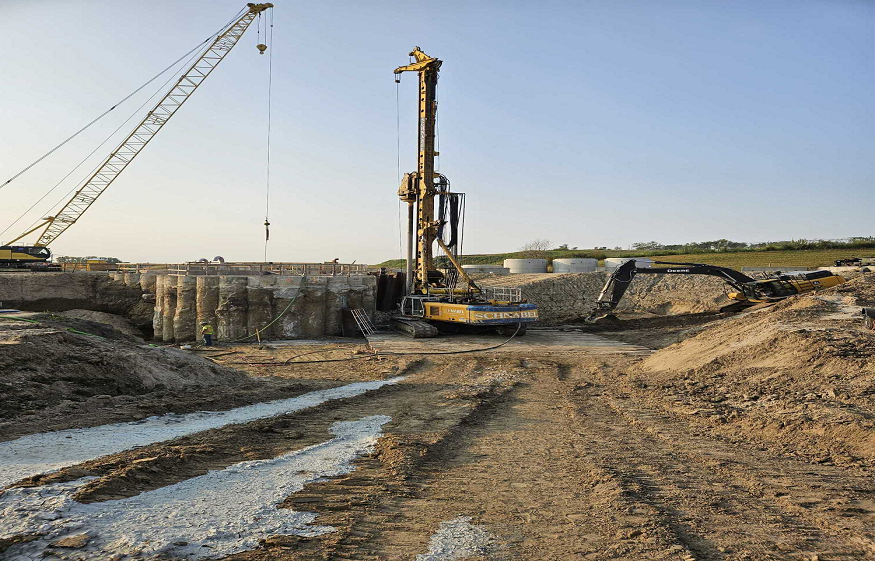
When a project calls for ground treatment, the decision usually comes down to site conditions, schedule, and what the finished system needs to do. Two methods that often come up in the same conversation are secant shaft walls and soil mixing. Both can create a continuous, low-permeability barrier. Both can support excavation. Both have a track record on complex urban and infrastructure work. But they are not interchangeable, and choosing the wrong one can drive up cost, slow the schedule, or leave a gap in performance that shows up later.
This article walks through how each method works, where each one performs best, and the factors that should guide the choice on a real project.
What a Secant Shaft Wall Actually Is
A secant shaft wall is built from a row of overlapping drilled shafts. The sequence is straightforward. Primary shafts are drilled and filled first, typically with a weaker concrete or a controlled low-strength material. Secondary shafts are then drilled between them, cutting into the primaries on either side, and filled with structural concrete. The overlap is what creates the continuous wall.
The result is a rigid, structural barrier that can carry vertical load, resist lateral earth pressure, and act as a groundwater cutoff. Because each shaft is drilled and concreted individually, the wall can be built tight to property lines and in confined sites where other methods will not fit. The method is well suited to deep circular shafts, rectangular excavation support, and sites where the finished wall needs to do structural work, not just hold back soil or water.
Secant shaft walls are common on transit and tunnel projects, deep utility installations, and below-grade structures in dense urban environments. They are also used when the wall will become part of the permanent structure rather than a temporary shoring system that gets removed later.
How Soil Mixing Works
Soil mixing takes a different approach. Instead of removing and replacing the ground, it modifies the ground in place. A mixing tool advances into the soil while injecting a binder, usually a cementitious slurry. The tool blends the native soil with the binder in place, creating a treated mass with improved strength and reduced permeability.
The process can be done in columns, panels, or full blocks depending on the equipment and the design intent. Overlapping columns form a continuous treated zone that can serve as a cutoff wall, a retaining structure, or a stabilized base for excavation. The treated soil gains strength over time, and the final properties depend on the soil type, the binder mix, and the mixing energy applied.
Soil mixing is used for groundwater control, liquefaction mitigation, slope stabilization support, and treatment of soft or contaminated ground. It is also used to create working platforms and to reduce the volume of material that has to be excavated and hauled off site.
Where Each Method Performs Best
The two methods overlap in capability, but they tend to fit different project profiles.
Secant shaft walls are the stronger choice when the wall needs to carry significant structural load, resist high lateral pressures, or serve as a permanent structural element. They are also favored when drilling through hard or variable strata where mixing tools may struggle to achieve consistent treatment. The discrete shaft construction allows the wall to be built in tight access conditions and to tight tolerances.
Soil mixing is often the better fit when the goal is broad ground improvement over a large area, when groundwater cutoff is the primary function, or when reducing spoil handling is a priority. It tends to be more cost-effective on larger footprints where the continuous treatment of a wide zone matters more than the structural capacity of any single element. It also generates less spoil than removal-and-replace methods, which can be a meaningful advantage on sites with disposal constraints or contaminated material.
Site Conditions That Should Drive the Decision
The subsurface profile is usually the first factor to evaluate. Soil mixing relies on the ability of the mixing tool to penetrate and blend the in-place soil. Very dense layers, cobbles, boulders, or obstructions can slow production and produce inconsistent treatment. Secant shafts can drill through many of these same conditions, though hard drilling will affect cycle time and cost.
Groundwater conditions matter for both. A secant shaft wall can be designed as a near-water-tight barrier, but the quality of the overlap between primary and secondary shafts is critical. A defect in the overlap can create a seepage path. Soil mixing creates a more continuous treated mass, but the permeability of the finished product depends on achieving uniform mixing throughout the column. Quality control testing is essential for both methods, and the testing approach differs.
Site access and overhead clearance can rule one method in or out. Secant shaft rigs need room to drill and place concrete, but the footprint per element is relatively small. Soil mixing rigs also need access, and the layout of overlapping columns or panels requires space to maneuver and maintain continuity. On constrained urban sites, the equipment footprint and the ability to work around existing utilities often become the deciding factor.
Schedule and Cost Considerations
Neither method is universally cheaper. The cost comparison depends on the wall geometry, the ground conditions, the required performance, and the production rates achievable on that specific site.
Secant shaft walls involve a sequential drilling and concreting operation. Each shaft is a discrete cycle, and the overlap requirement means the secondary shafts cannot be drilled until the primaries have reached sufficient strength. That sequencing is manageable but it does set a pace. On deep walls or walls with many shafts, the cumulative cycle time can be significant.
Soil mixing can achieve higher production rates over large areas because the process is more continuous. However, production can drop quickly in difficult ground, and the need to achieve design strength before excavation or loading adds a curing period to the schedule. The binder mix design and the required strength gain curve should be confirmed early so the schedule reflects realistic curing time.
On cost, the rule of thumb is that secant shaft walls tend to be more expensive per linear foot but are often the only option that meets the structural requirement. Soil mixing tends to be more economical on larger treatment volumes where the continuous process and reduced spoil handling offset the setup and mix design costs.
Quality Control and Verification
Both methods require a quality control program that matches the performance requirement. The difference is in what gets tested and how.
For secant shaft walls, the focus is on verticality, overlap integrity, and concrete quality. Verticality controls whether the overlap is maintained over the full depth. Crosshole sonic logging and concrete cylinder testing are common verification tools. For deeper or more critical walls, additional integrity testing may be warranted.
For soil mixing, the focus is on the uniformity and strength of the treated mass. Wet grab samples, cored samples, and in-place testing such as the standard penetration test on treated columns are used to confirm that the design strength and permeability are being achieved. The variability of native soil means that quality control is not a one-time check. It is a continuous process tied to production.
The verification program should be defined during design, not after construction starts. Waiting until the wall is in place to figure out how to confirm it works is a common source of cost overruns and schedule disruption.
Read More: Which SAS Training Institutes in Hyderabad Have Experienced Trainers?
Common Reasons Projects Get the Choice Wrong
The most frequent mistake is selecting the method before the subsurface conditions are fully understood. A wall that looks efficient on paper can become a production problem if the ground does not cooperate. A thorough geotechnical investigation, including information on the specific strata the wall will be built through, is the foundation of a sound decision.
A second common error is underestimating the curing or strength gain requirement. Both methods involve materials that gain strength over time, and the schedule needs to reflect that. Pushing excavation or loading before the treated material or concrete has reached design strength is a risk that shows up as movement, seepage, or structural distress.
A third is mismatching the method to the performance requirement. Using a ground improvement method where a structural wall is needed, or building a structural wall where ground improvement would suffice, is a cost and constructability problem that good early coordination can prevent.
A Practical Approach to the Decision
Start with the performance requirement. What does the wall or treated zone need to do? Carry load. Cut off groundwater. Support excavation. Resist lateral movement. Become permanent. The answer narrows the options quickly.
Then look at the ground. The subsurface investigation should tell you whether the conditions favor drilling discrete elements or mixing the soil in place. Dense layers, obstructions, and variable strata push toward methods that can handle them. Uniform, treatable soils open the door to mixing.
Then evaluate access, schedule, and cost together. A method that fits the performance and the ground but cannot be built within the site constraints or the timeline is not the right method. The decision is a balance of all three, not a ranking of one over the others.
Finally, involve the specialty contractor early. The people who build these systems every day can identify constructability issues that do not show up in a design document. Early input from a specialty geotechnical contractor can confirm whether the selected method is buildable as designed, or whether a different approach would deliver the same performance with less risk.
Read More: How Retail Investors Evaluate Strong IPO Opportunities in India
The Bottom Line
Secant shaft walls and soil mixing both have a legitimate place in ground treatment. The choice between them is not about which is better in general. It is about which is better for the specific wall, the specific ground, and the specific project. Getting that decision right early saves cost, protects the schedule, and reduces the risk of performance problems during construction. Getting it wrong usually shows up when it is most expensive to fix.